Monday, November 4, 2013

LESSON VII - Part 2: Ten Things to Know about Green & Ten Sketchbook/Color Exercises to Try


Here are 10 things that I think you should know about the color Green, along with 10 sketchbook exercises and color studies for you to try:


1.  The Greens in nature are extremely varied, ranging from the yellowish green of a fresh Boston lettuce, to the khaki green of a late summer tree, to the blue-green of a Colorado Blue Spruced.  When you encounter a forest landscape, your first impression is that it is entirely green.  But, if you really look -- really SEE it -- you will find that it contains many other color jewels within.

The color harmonies of Green mostly mark two of the seasons -- spring and summer.  Think of spring's bright greens and yellow-greens, and summer's lush deep greens and blue-greens.  The color of grass and leaves are constantly transformed by light and shadow, too.


Sketchbook Exercise #1 -- Draw a scene, with trees in your yard, in pen.  Then, add some color with your watercolors.  Write about your experience, in one sentence, on your page . . .


Now, go for a little hike or walk.  Stop at a place that appeals to you, and draw some of the trees in ink.  Write about where you are, and then add some color with watercolor -- either on the sport, or after you return home. . . 


2.  Natural Greens are predominantly warm, so Yellows and Reds need to be included in your Green mixtures.  Greens are challenging, but they can be beautiful, can look natural, and can even be transparent.

Don't be afraid to use green, and don't use the same boring green everywhere.  Try to use a colorful blend of Green mixtures and tube Greens.  For colorful greens, mix Yellow and Green together first, and then naturalize the mix with a small amount of Rose.


Sketchbook Exercise #2 -- Draw a bird's eye view of a plant -- either a houseplant or a plant in your garden.  Draw this in pencil, and then add some color with colored pencils . . . 


3.  Use both tube Greens and mixed Greens, but always add another color to your tube Greens.  Many artists mix their greens, instead of finding the correct color in a tube for convenience.  And, certain pigments, like Winsor (Phthalo) Green, are way too bright, overpowering, and unnatural to use alone.  You may be better off mingling Yellows and Blues to get the Greens you want; however, you can also use tube Greens, like Sap Green, and add other colors to it.


Sketchbook Exercise #3 -- A helpful exercise for you to do is this mixing exercise.  Draw a grid on watercolor paper.  Label and put all your Yellows across the top (including Quinacridone Gold and Raw Sienna).  Then, label and put all your Blues and your tube Greens down the side of the grid.  

Paint the Yellows first -- all the vertical strips.  You can be pretty bright with your Yellows.  When those strips are dry, paint the Blues and Greens next -- all the horizontal strips.  Stay very transparent with the Blues and Greens, so you can see what Greens your paints will produce.


4.  Winsor Green (Phthalo/Thalo) is an unnatural color, when used alone -- with a strange, blue tinge.  But it can still be a useful color for your palette.  Phthalo Green is a cool, staining, transparent color, primarily used for mixing darks.  Use Phthalo (Winsor) Green + Alizarin Crimson for your darkest greens.  If you add equal parts Winsor Green and Alizarin Crimson, it becomes a beautiful Black.

For rich, dark greens, start with Phthalo Green, and add a Yellow to it, to get a very transparent dark.  If this green mixture is too vibrant and unnatural, it can be tamed with a bit of Quinacridone Rose or Quinacridone Burnt Orange (either added to the mixture, or glazed on top).  Also, a nice Yellow-Green can be made with Phthalo Green +Aureolin Yellow, with a touch of Quinacridone Rose, to make it look more natural.  Mix the Phthalo Green and the Aureolin Yellow together first (you will need more yellow than green in this mix); then, add the Rose.

Try creating different dark greens, starting with Winsor Green, and adding various yellows.  These mixed greens will be less harsh and more varied than using Winsor/Phthalo Green right out of the tube.


Sketchbook Exercise #4 -- Draw one or two trees, simplifying the shapes.  Draw clumps of leaves and not individual leaves.  Mingle the greens within the shapes, using some of the mixtures above.  


5.  Permanent Sap Green -- warm and transparent, nongranulating and nonstaining -- is a good choice of green for your palette.  A basic transparent Green mixture is Sap Green + Aureolin Yellow.  Then, add a touch of Rose for a natural landscape Green which stays transparent.  You can neutralize Sap Green with a Rose or a Red, for a bronzy Green.  Sap Green + Quinacridone Rose makes a nice Gray-Green.


Sketchbook Exercise #5 -- Draw some "Green" Flower Doodles, in pen.  And then, color them with markers or watercolors.


6.  Some suggestions for mixing interesting Greens:

- Mingle Sap Green + French Ultramarine, for middle value foliage or foliage in shadows.
- Mingle Sap Green + Quinacridone Rose to gray down foliage a little.
- Mingle Sap Green with Cobalt Blue + Quinacridone Gold for grass in sunlight.
- Mingle Sap Green with Quin. Burnt Orange + Phthalo Blue for an intense dark green.
- Mix Sap Green + Raw Sienna + Cobalt Blue for a gray-green.
- Don't use Yellow Ochre in a green mixture -- it's too opaque, so the mixture is not luminous.
- Don't add a 4th pigment to any mixture -- that's when your greens will get muddy and opaque.
- Whenever a green in your landscape is too vibrant or unnatural, it can be tamed with a bit of Rose or Burnt Sienna, (either added to the mixture, or glazed on top).


Sketchbook Exercise #6 -- Negative Painting of Foliage.  Start with wet-in-wet underpainting.  Draw some leaves of a houseplant, in the foreground.  Then, mingle colors in the negative space.  Draw the next layer of foliage, then mingle some more greens in the negative space.  Continue for as many layers as you want . . . 


7.  Remember that your Warm Greens will come forward, visually.  Try making your distant Greens slightly grayer and cooler (bluer).

To make your foreground foliage brighter and warmer, mix some Yellow and Burnt Orange into your Greens.  Distant trees should be cooler and a little grayer, so add more Blue into the mix.

In fact, underpaint the foreground with a warm Yellow and the background with a light Blue, before painting any Greens.


Sketchbook Exercise #7 -- On a small piece of watercolor paper, use a resist (like masking fluid, or a wax crayon, or torn masking tape) to draw some wavy lines.  Then paint a wet-in-wet wash, starting with warm greens at top and gradually moving to cool greens at bottom.


8.  Green and Red are the warmest of the complements, and so, the most cheerful!  Evenly matched partners (since they are both warm and both of a middle value) -- setting up a vibration when they touch, like optical glitter.  

In even the most abstract art, Green reminds us of nature's greenery, and Red reminds us of its flowers.

If your green is overly bright, use a transparent glaze of Quinacridone Rose over it, to cut the intensity.  

If you have a bright red in the background that needs to be calmed down -- use a very light glaze of Winsor Green over it.

Make your tree trunks reddish brown to make the leaves of the trees look brighter.


Sketchbook Exercise #8 -- Draw and paint some small studies of leaves.  Make some Blue-Green, and lift out the veins.  Make some of the leaves Red, with a Blue-Green background.  Make some of the leaves Green with a warm Red background.


9.  Using an analogous color scheme in a nature painting breaks up the monotony of green and creates excitement in your painting.  Start with the main object's local color (green) and build an analogous color scheme around that.  (Remember that analogous colors are next to each other on the color wheel.  

Since the local color of leaves is green, use more yellow in the areas closest to the light source and more blues in the shadows.

Use analogous greens and yellows to dominate in a nature painting, with a touch of reddish brown added for contrast.  (That is a foolproof color combo!)


Sketchbook Exercise #9 -- Do some contour line faces in black ink, on top of some green under paintings . . . 


10. Try some "Optical Mixing", with Yellow and Blue -- where juxtaposed colors are blended by the viewer's eye.  This is called Pointillism, and was used by Georges Seurat, a Post-Impressionist artist.  To paint a large grassy area, he painted an undertone of Green, and then built up areas of light and shadow, using dots of Yellow, Orange, Violet, and Blue.  This would be a good way to add some variety to a big area of Green in your painting.


Sketchbook Exercise #10 -- I actually want you to use your camera for this.  Take some "Green" photos, to use as reference for future paintings, and for the Painting Challenge for this lesson.  Take close-up shots of houseplants -- in your house, or a friend's house, or at a florist.  Place special emphasis on the leaves, rather than the flowers.  


LESSON VII - Part 1: Painting Green Apples on a Window Sill


In this watercolor project, we'll be painting a few Granny Smith apples, sitting on a windowsill in the kitchen, with patterned tiles beneath the sill.  We'll be using various techniques, including transparent layering, mingling, glazing, and a little salt, at the end this time, for texture.

Use these 7 different pigments for this project -- Aureolin Yellow, Quinacridone Gold, Quinacridone Rose, Quinacridone Magenta, Cerulean Blue, Cobalt Blue, and Sap Green.  Substitute with something similar, if you need to.


Prep 3 colors on your palette, to be used for the wet-in-wet underpainting:  Aureolin Yellow, Quinacridone Rose, and Cerulean Blue . . .


Wet your paper with clear water.  Then paint these three colors, in "stripes".  Since we're painting wet-in-wet, there should be no hard edges to these stripes . . . 


Let this dry on a flat surface.  While this is drying, find your reference material.  I set up 3 green apples on a window sill and took some pictures.  You can set up your own "still life", or work from these photos, or from my drawing . . . 


When the underpainting is completely dry, do a pencil drawing.  Start by drawing a straight horizon line, about a third of the way down from the top.  Measure and use a ruler for this line.  If it's not level, it will look as if the apples are going to roll off the ledge.  Now, draw a few apples, sitting on this line.  Add a few more horizontal lines to indicate a window sill, and then draw a simple pattern underneath the sill . . . 


Clean off the middle of your palette, and now mix up a simple Yellow wash.  Paint each apple with this yellow was, wetting each first with clear water.  Then, paint some of the pattern shapes Yellow . . . 


To the Yellow wash on your palette, add some Cerulean Blue, to make a Green.  Also, prep some Sap Green, mixed with a little Cerulean Blue.  Wet each apple separately with water, and mingle these colors in each apple.  Then, mix a Cerulean Blue wash, and paint some of the pattern shapes with this Blue.  Paint this Blue over some of the Yellow shapes, too, in order to make a Green . . . 


Clean off your palette, and mix a wash of the Quinacridone Rose.  Paint the windowsill with this Rose wash.  When that is dry, paint another layer of the same Rose wash on the middle shape of the sill.  Then, use this Rose to paint a few more of the pattern shapes.  If you paint the rose over some of the Blue shapes, it will make a Violet.  When you paint the Rose over some of the Yellow shapes, it will make an Orange . . . 


When this is dry, paint a wash of Quinacridone Gold over the windowsill, to warm it up.  Then, use the same wash to paint a few more pattern shapes and the lines between the squares . . . (you could also leave the shapes between the squares unpainted)


After that is completely dry, paint a few darks in the apples -- right at the bottom of each (Sap Green plus Cobalt Blue), and the stems (Magenta plus Blue plus Quin Gold).  Use the dark magenta to paint a dark under the windowsill, to give it some dimension.  Now, paint some magenta pattern shapes.  Paint some shapes within the shapes.  No need to draw these first, unless you want to.


To finish your painting, paint a glaze (pale wash) of Cobalt Blue over the patterned area.  When there is just a sheen on the paper, sprinkle some salt on the wash and let it dry.

When that is completely dry, brush off the salt . . . 


This final Blue glaze subdues the pattern a little, and the salt gives it a subtle, "weathered" look.  Your focal point should be the apples and not the pattern.  If they complete with each other, you need to tone down one.  (There can't be two stars of the show.)


LESSON VII - Green


Lesson VII is all about the color, Green.

Green is the pervasive color in nature -- we see it everywhere.  The natural greens, from forest green to lime green, are seen as tranquil and refreshing.  Green is the color of peace and ecology.  In fact, it is synonymous with ecology.


This Lesson VII is made up of 4 parts:

Part 1:  Painting Green Apples on a Window Sill


Part 2:  Ten Things to know about Green and Ten Sketchbook/Color Exercises to try


Part 3:  Painting an Abstract Landscape


and
Part 4:  Green Painting Challenge


Let's get started -- Hope you enjoy this Green lesson!


Tuesday, October 8, 2013

LESSON VI - Part 3: Primary Triad Mandala

In this project, we will be drawing and painting a Mandala, using the Primary Triad (Blue, Red, & Yellow).  We will be layering the colors, in order to create more colors, and shapes within shapes.


To draw the mandalas, we will use some old-fashioned drawing tools -- a compass, a protractor, and a ruler/straight-edge . . . 


On dry watercolor paper, draw a big circle with your compass.  It's good to draw the circle with a compass rather than tracing around a dinner plate, because you will need the center dot (hole) to use as reference for your other circles and radial lines.

Now, draw a few concentric circles within the big one, with various diameters.  Then, using your straight edge, draw a straight line through the center hole -- essentially cutting your circle in half.  (This does not have to be parallel to the edge of your paper, but it can be.)

Take your protractor and position it over the straight line -- the little circle on the protractor lines up with the center hole, and the line lines up with the 0 degree marks.  Make a small mark with your pencil at 60 degrees and 120 degrees.  Then, line up the protractor on the other side of the line, and make your marks at 60 degrees and 120 degrees, on the other half of the circle . . . 


Using your straight-edge, connect the dots to draw your radial lines.  Make sure your straight-edge lines up with the center hole and two of the dots, so that you are drawing lines across the diameter of the circle.


Now, we will draw a few big shapes before we start painting.  From now on, draw your shapes freehand, using your construction lines and circles as reference points.  Start towards the middle, draw a shape and repeat it all around the circle.  Then, go to the next level, draw another shape and repeat it all around the circle . . . and continue until you're at the outside of your circle. . . 


Now, it's time to paint.  First prepare a Yellow wash, and paint some of your shapes with it.  You'll be painting "wet on dry".  You won't be using any more Yellow after this stage, so make sure your wash is nice and bright.  Next, prepare a light Cobalt Blue wash, and paint the outer circle and "box", painting around the slivers of yellow . . . 


After this is dry, prep a wash of Quinacridone Rose.  Paint over the white shapes, as well as the Yellow teardrop shapes, which will turn them Orange . . . 


While the Rose wash is drying, draw another scalloped circle, within the outer circle (on the Blue).  After the Rose wash is dry, draw a shape within the Orange teardrop shapes.  Lastly, draw two more circles -- one within the "sunflower" shape, and another one inside the circle that touches the tips of the "sunflower petals" . . . 


Now, mix up and paint the following colors, separately:

1)  Quinacridone Gold -- the shapes within the "sunflower" shape.

2)  Permanent Red + Quinacridone Gold -- the inner teardrop shape plus the inner background shapes.

3)  Phthalo Blue + Cobalt Blue -- the outer scalloped circle (leaving the outermost circle untouched).  Also, paint over the yellow slivers, at the same time, changing them to green.


Using the Blue wash, paint the corners of the "box" . . . 


Now, we'll add some more shapes and darks.

Draw some more curved shapes, next to the Green slivers, and then paint them with Phthalo Blue.  Paint a few of the shapes inside the inner circle, with this Blue, too.

With Permanent or Quinacridone Magenta, paint a few smaller shapes within some of the Orange shapes . . . 


Draw some curved lines in pencil on the outermost rose circle.  (I know it looks orange in this picture, but it should be rose.)


With the Permanent or Quinacridone Magenta, paint the smaller shapes that the curved lines created.  Now, mix up a dark purple (Magenta & French Ultramarine), and paint a few dark shapes around and within your mandala . . . 


I hope this is the first of many mandalas you draw and paint.  They seem to be like snowflakes -- no two are the same.


LESSON VI - Part 2: Ten BLUE Sketchbook/Color Exercises to Try

Try a few, or all, of these "very cool" BLUE exercises . . .


For the first few color studies, you will need some watercolor paper (this can be a watercolor sketchbook, paper from a watercolor pad, scraps of good watercolor paper, or the backs of your old paintings).


1)  FACES --

Start with a wet-in-wet underpainting, using all your blues, and a few analogous colors (like green and magenta).  Let this dry completely.

Find some faces from your magazines, and tear them out to use for references.  (For this exercise, I recommend NOT using photos of people you know, because then you'll be too worried about getting a likeness).  Don't worry about that.

Cut up your painted watercolor paper into 4 x 6 pieces, and do a contour drawing of a face, using a black felt pen, on each piece.  Try at least one face, but not more than 6 . . .


2)  A WINTER SKETCH --

Without drawing first, paint a quick color sketch, that gives the "feeling" of winter . . . 


3)  A FISH "OVER" WATER -- 

Start with a wet-in-wet mingling on a small piece of watercolor paper, using a granular blue (like French Ultramarine or Cerulean Blue), plus a little of an earth color or two (like Quinacridone Gold).  When this is dry, draw a fish, and then paint it, keeping most of the fish transparent, so as not to totally cover up the underpainting.  Finish with a few darks on the fish . . . 


4)  BLUE "WAVES" -- 

On dry paper and using a big brush, paint some big wavy, watery swaths of color -- mostly blues, with a little magenta and/or red -- and leaving just a few bits of white showing.  While this is drying, paint some more wavy lines, using more pigment this time (French Ultramarine and Phthalo Blue).  Finish with a little spattering of red . . . 


5)  SAILBOATS SURROUNDED BY BLUE -- 

With a soft 6B pencil, or a charcoal pencil, draw a sailboat in the water, near a dock or harbor.  With your watercolors, paint some wet blues for the sky and the water, leaving some white shapes unpainted.  Add a few spots of bright warm color, and finish your sketch with some darks (pencil or paint).


Use your sketchbook for the rest of the exercises . . . 


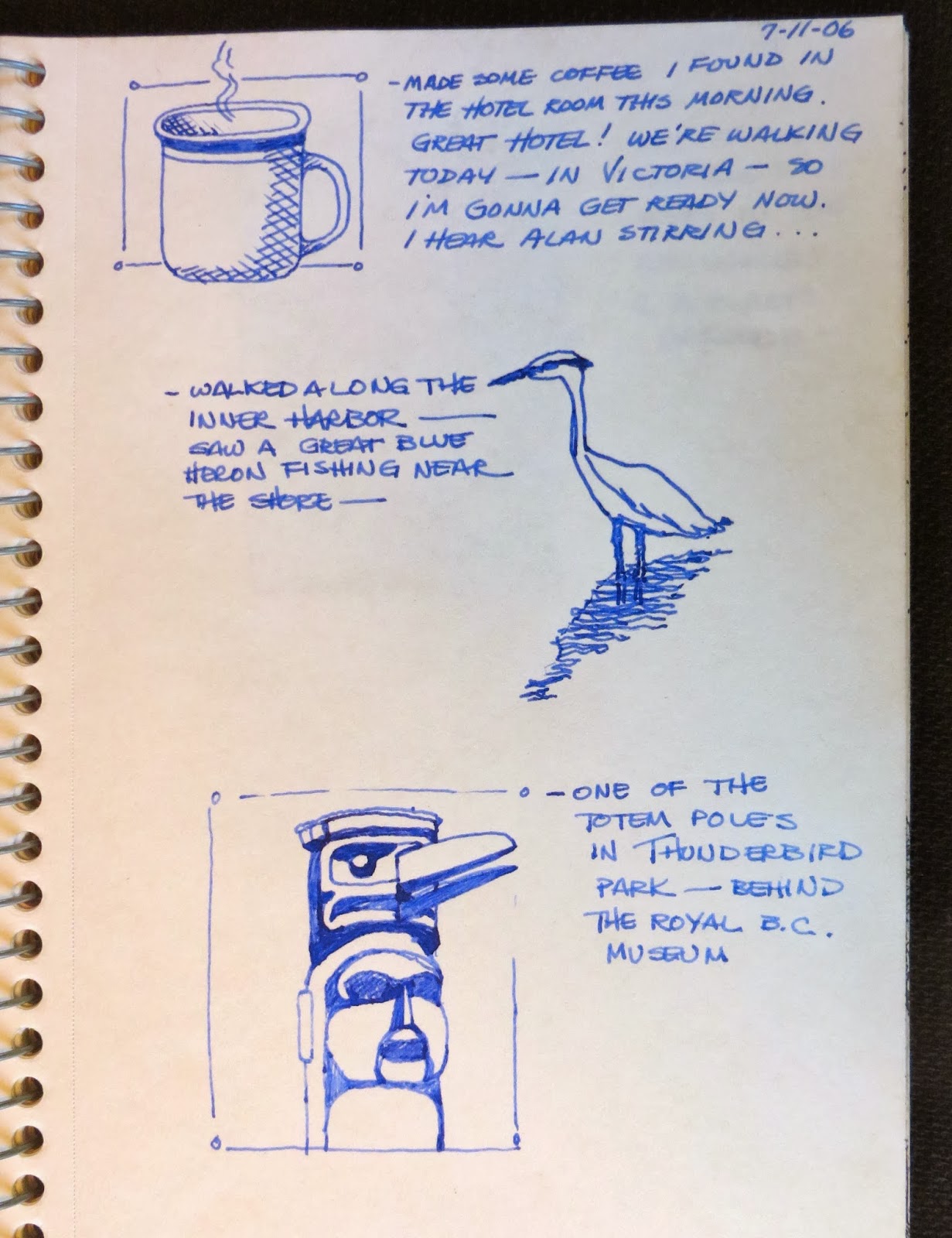
6)  IMPRESSIONS OF YOUR DAY -- Using a blue fine marker, or even a blue ballpoint pen, draw a few images of some things in your environment. And then, jot down a line or 2 next to each one -- all on the same sketchbook page.  Then, date the page . . . 


7)  A "BLUE" BIRD -- 

Draw a "blue" bird, either from life or from a photo, in pencil.  Add color with colored pencils (or watercolor pencils), using different blues, and adding a few spots of warm colors for contrast . . . 


8)  FLOWER DOODLES --

Find pictures of a few blue flowers, or you can use my doodles as reference.  

Now, just start drawing the flowers, shape by shape, with a black felt pen.  Once you're filled up your sketchbook page with your lines, you can add color with markers or colored pencils.


Comedian Larry David, in HBO's "Curb Your Enthusiasm" said, "I can't draw to save my life, but yet, I'm a very good doodler".


9)  BLUE CONTOUR DRAWINGS --

Using a blue felt tip pen, draw one or two contour drawings of something in your home . . . 


10)  JUST FOR FUN -- 

While looking at a stone wall, draw just the cracks, with a contour line in black felt pen.  Choose one of these shapes and turn it into a little creature.  Draw a frame around it with some lines in the background, to break up the negative space.  

Now, try some paint "sanding", in some of the background shapes.  Wet one of the shapes with clear water, and then, rub the end of any blue watercolor pencil on a sandpaper block, so the particles land on the wet shape.  (This only works with watercolor pencils, not regular colored pencils.)


All right!  Now, it's time for a cup of hot tea or coffee -- to warm up after all this COOL BLUE drawing and painting . . . 


LESSON VI - Part 1: Blue Sky Sampler


Draw a grid on one piece of watercolor paper, separating your paper into 4 quadrants.  Or, you can use 4 separate little rectangles of paper.


Paint a different blue sky in each one --

(Upper left quadrant) - Wet the paper first with clear water; then, paint two different blues.  As it is drying, roll a little piece of tissue across the paper, for clouds.

(Upper right quadrant) - Wet the paper; then, paint a pale blue and a very pale magenta.  Then lift out some of the paint with a damp brush, as it's drying.


(Lower left) - Draw and mask out a little circle, for the moon, using masking fluid.  Wait for the masking to dry, and then paint the sky with two different blues.  Roll a tiny piece of tissue across the moon for a cloud.  If the sky is not dark enough for a night sky, wait until it is dry, and paint it again with the blues.  Remove the masking after it is dry.

(Lower right) - Paint a blue wash onto dry paper.  While this is still wet, paint a few "stripes" of another blue.  Roll a piece of tissue for the clouds.  

LESSON VI - Blue


This Lesson is all about cool and calm BLUE, the overwhelming "favorite color".


BLUE surrounds us -- it is the color of peace, order, strength, and the spirit -- symbolized by the blue sky and the vast blue ocean.  BLUE evokes serenity, innocence, truth, sadness.


Here are 10 important things about the color BLUE that I think you should know:


1)  BLUE IS THE COOLEST COLOR ON THE COLOR WHEEL -- bringing a soothing element to any painting.  Of the three primary colors, it is the only cool one.


2)  BLUE VISUALLY RECEDES.  Any color that we associate with the sky -- especially the blues -- tend to be recessive, stubbornly recessive.  Another characteristic of BLUE is its POWER TO SUGGEST INFINITY or DEEP SPACE -- beyond that of any other color.  Because of this, blue is a good color to use for your background, and also as a glaze, in order to set something back in space.


3)  BLUE'S COMPLEMENTARY COLOR IS ORANGE.  Side by side, these two colors create a vibrancy.  Interestingly though, if you put these two colors next to each other, at the same intensity and the same size, the cool blue will still recede, and the warm orange will still advance.


4)  YOU SHOULD HAVE AT LEAST 3 BLUES ON YOUR PALETTE, since all blues are not considered equal.  Blues have what's called a "hue bias", which is the different mixing potential of each blue (whether the color leans towards green or red).  It's good to have a blue with a GREEN BIAS, like a Phthalo Blue; a blue with a RED BIAS, like French Ultramarine; and a good blue for glazing, like Cobalt Blue.  Having a green bias, means that this blue will mix with yellows to make beautiful greens. Having a red bias, means that this blue will mix nicely with cool reds to make violets.


5)  PHTHALO BLUE (also known as Winsor Blue or Rembrandt Blue) is a BRIGHT AND INTENSE BLUE THAT CAN BE VERY DARK.  Used as a thin glaze, it is very transparent.  It is a staining pigment, which means it is hard to lift.  Phthalo Blue can easily overwhelm other colors, unless it is used sparingly.  But, this makes it excellent for mixing darks.


6)  COBALT BLUE IS AN ESSENTIAL BLUE FOR YOUR PALETTE -- GOOD FOR PAINTING SKIES & SHADOWS, BUT NOT GOOD FOR DARK MIXTURES.  I use it a lot for glazing and in portraits.  Cobalt Blue is translucent and lifts easily.  It's also somewhat toxic, by the way.  This is a great all-round color for underpainting, layering, and mixing with other colors -- just not for dark mixtures.


7)  FRENCH ULTRAMARINE -- A SEDIMENTARY COLOR -- CAN BE VERY USEFUL, DEPENDING ON WHAT YOU'RE PAINTING.  Because of its granular quality, it's good for painting beach scenes, landscapes, barns -- but, not for skies and portraits (at least not for the skin).  Use French Ultramarine, mixed with Quinacridone Burnt Orange, when painting rocks, trees, bark, and stone.  

This color is attractive when applied wet-in-wet, because it settles and doesn't spread uncontrollably.  French Ultramarine is a very saturated royal blue, biased slightly toward red, so it makes a beautiful purple.  This color will dry lighter than you think, and it lifts easily.

The highest quality Ultramarine Blue is made with powdered lapis lazuli from Afghanistan.  (Not really important for you to know, I guess, but I thought it was interesting.)


8)  CERULEAN BLUE IS A BEAUTIFUL, LIGHT BLUE PIGMENT THAT CAN ACT AS A TRANSPARENT COLOR, WHEN MIXED WITH LOTS OF WATER AND APPLIED TO WHITE PAPER.  It is not a good color for mixing or glazing/layering, since it is fairly opaque and can be rather chalky in mixtures.  It also has a granular quality, and is a good pigment for spattering.


9)  BLUES MAKE BEAUTIFUL, "COLORFUL" GRAYS.  I know that seems like an oxymoron, but the grays you get when mixing blues and other colors, are so much more interesting than the tube grays.  You're able to "push" the gray towards blue or rose.  You can also apply a cobalt blue glaze over a busy or too-bright background, to gray it a little and calm it down.  Using a blue mixture for your shadows is much more effective and harmonious than just using a Payne's Gray wash, for example.


10)  BLUE HAS A BROAD VALUE RANGE, from tints to shades (unlike yellow, which never gets dark, without turning into brown).  Strong blue hues retain their color identity at the darkest value, and at the lightest value (unlike red, which becomes pink at its lightest value).